

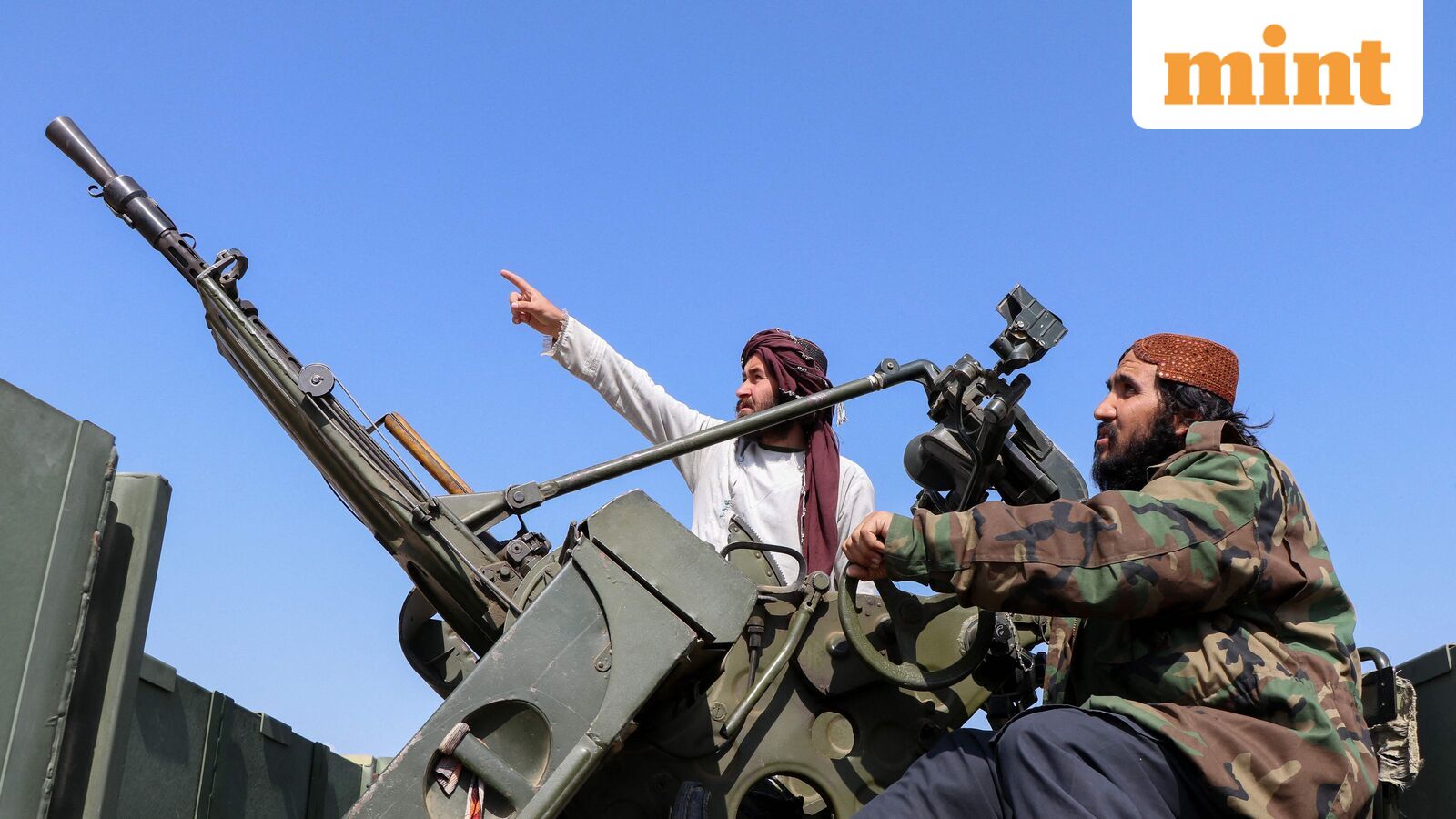
Pakistan carried out airstrikes in Kabul and two other Afghan provinces early Friday, Afghanistan’s government spokesperson said, hours after Afghanistan launched a cross-border attack on Pakistan in the latest escalation of violence between the neighboring countries that made a Qatar-mediated ceasefire appear increasingly shaky, news agency AP said.
At least three explosions were heard in Kabul, but there was no immediate information on the exact location of the strikes in the Afghan capital, or of any potential casualties.
Afghanistan said Pakistan also carried out airstrikes in Kandahar to the south and in the southeastern province of Paktia. Khawaja Asif, Pakistan’s Defense Minister, acknowledged the Pakistan strikes and declared an ‘open war’ on the Taliban government in Afghanistan on Friday, hours after Pakistan airstrikes.
Tension has been high between Afghanistan and Pakistan – the two neighbors for months — with deadly border clashes in October killing dozens of soldiers, civilians and suspected militants.
The violence that followed explosions in Kabul Afghan officials blamed on Pakistan. Islamabad, at the time, conducted strikes deep inside Afghanistan to target militant hideouts.
A Qatari-mediated ceasefire was agreed on between the two sites on October 19 last year. The ceasefire has largely held, but the two sides have still occasionally traded fire across the border. Several rounds of peace talk in November failed to produce a formal agreement.
On Sunday, Pakistan’s military carried out strikes along the border with Afghanistan, saying it had killed at least 70 militants. Afghanistan rejected the claim, saying dozens of civilians had been killed, including women and children.
Pakistan welcomed the return to power of the Taliban in 2021, with then-Prime Minister Imran Khan saying that Afghans had “broken the shackles of slavery”. But Islamabad soon found that the Taliban were not as cooperative as it had hoped, according to a Reuters report.
Over the years, however, Pakistan has accused Afghanistan of harboring armed groups led by the Pakistan Talibanknown by its acronym TTP, on its soil.
“In response to the repeated rebellions and insurrections of the Pakistani military, large-scale offensive operations were launched against Pakistani military bases and military installations along the Durand Line,” Afghan Taliban spokesperson Zabiullah Mujahid confirmed on X said in a post on X Thursday night.
Clashes near the key Torkham border crossing between Afghanistan and Pakistan on Durand Line resumed on February 27, according to media reports.
What is the Durand Line?
At the heart of the confrontation lies the Durand Line, the 2,611-km frontier drawn during British colonial rule in the 19th century. It is named after Sir Mortimer Durand, a British civil servant who negotiated the agreement with Afghan ruler Abdur Rahman Khan.
The border divides ethnic Pashtun communities, which has fueled political and nationalist tensions.
In 1893, British India and Afghanistan signed an agreement to define their spheres of influence. The line split the Pashtun tribal areas, leaving many Pashtuns on both sides. After Pakistan was created in 1947, it inherited the Durand Line as its western border.
While Pakistan recognizes it as the official international border, successive Afghan governments have refused to formally acknowledge it.
Afghanistan Position
But successive administrations in Afghanistan, including the Taliban, have rejected the Durand Line, arguing that it divides the homeland of the ethnic Pashtun and Baloch populations.
Afghanistan has historically disputed the legitimacy of the Durand Line, arguing that the original agreement was imposed under British pressure and should not automatically apply to Pakistan.
Taliban has, at times, sent troops to impede Pakistan’s fencing of the boundary. Given that all past Afghan governments have refused to recognize this border, inherited from colonial times, it is hard to imagine the Taliban doing so, according to a recent report in the global think tank International Crisis Group.
The porous mountainous border has been a major route for militant movement, especially during the Soviet–Afghan War and the post-2001 conflict involving the Taliban.
With both sides trading casualty figures and accusations, the situation remains volatile, raising fears of a broader military confrontation in the region.
Regional instability concerns
Praveen Donthi, a senior analyst with the International Crisis Group, told LiveMint that the deepening distrust between neighboring nations is likely to lead to prolonged regional instability.
“Islamabad accuses Kabul of actively supporting the Tehreek-e-Taliban Pakistan and its attacks on Pakistani territory, while also blaming New Delhi for colluding with Kabul in this effort,” he said.
Considering that Pakistan, without presenting any evidence, has also been accusing India of supporting rebel groups in Balochistan, and India has been criticizing Pakistan for fomenting militancy in Jammu and Kashmir, the entire region is caught in a web of insurgency and counterinsurgency accusations, Donthi said.
This deepening distrust between neighboring nations is likely to lead to prolonged regional instability.
“This deepening distrust between neighboring nations is likely to lead to prolonged regional instability,” he said.

